7 Small Apartment Dining Nook Layouts to Compare Before You Buy
Compare seven small apartment dining nook layouts, with practical measuring tips for choosing a table before you buy.
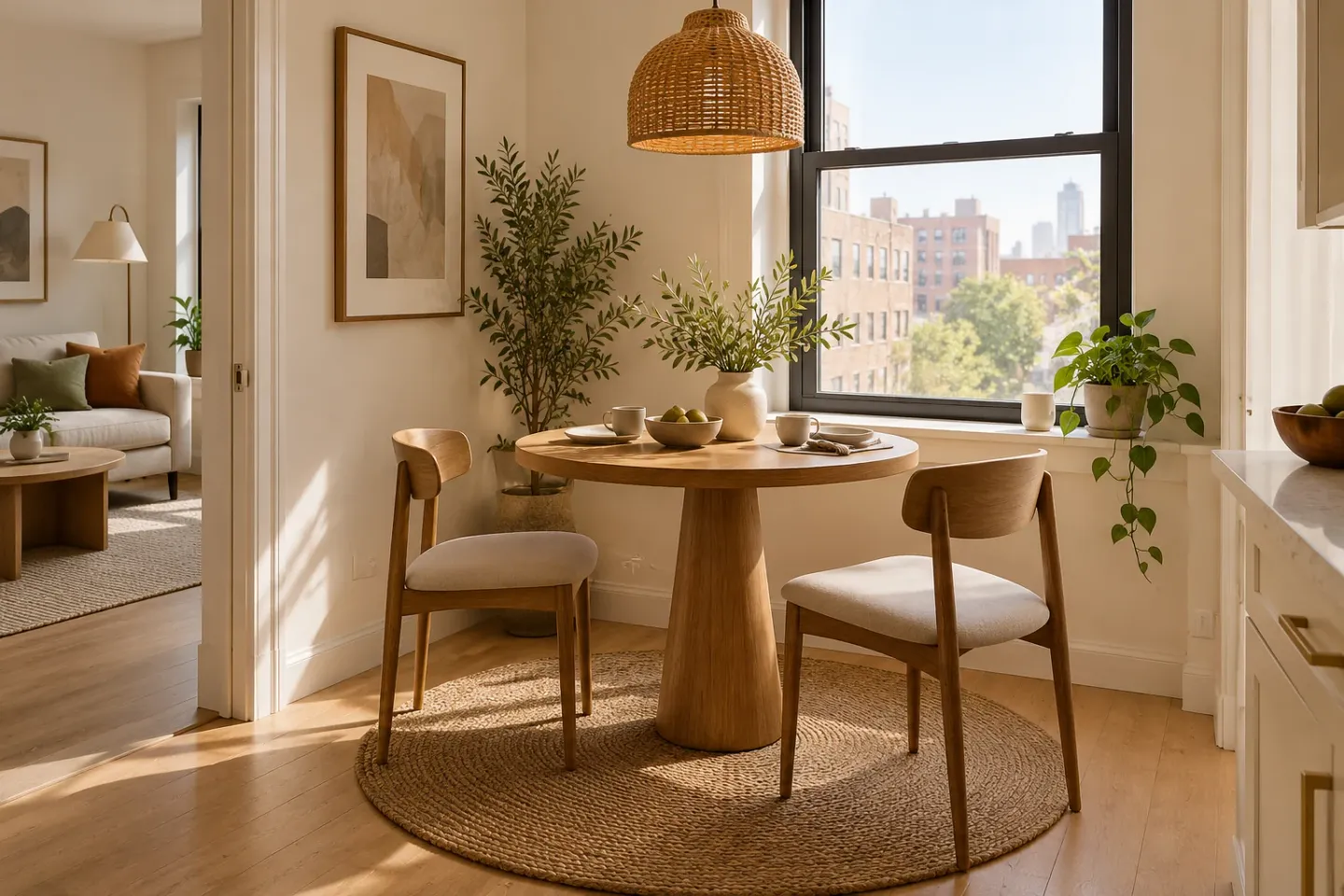
A dining nook can make an apartment feel settled, but the smallest table is not necessarily the easiest to live with. Chair movement, walking routes and eating habits matter as much as tabletop size. These seven layouts range from a round pedestal to a folding table. Compare them against your room and routines before buying. The imagery shows illustrative decorating concepts, not real renovations.
Before you rearrange: a practical checklist
Before-you-buy measurement checklist
- Measure fixed boundaries, projecting trim, heaters, outlets and window coverings; note door and appliance swings.
- Mark usual routes and preserve exits and applicable safety clearances. Test routes with chairs occupied and pulled out.
- Record table dimensions and leg or base positions, including open, closed and stored configurations.
- Check chair dimensions, arms and clearance beneath the table.
- Outline tables, chairs and leaves with paper or finish-safe tape, then test the arrangement.
- Compare packaged dimensions with entrances, stairs, elevators and doorways; confirm whether furniture arrives assembled.
Compare the options
Compare the layouts
| Layout | Best fit | Tradeoff | Key check |
|---|---|---|---|
| Round pedestal | Multiple approaches | Gaps against wall | Base and chairs |
| Square two-person | Compact wall | Intrusive corners | Chair fit between legs |
| Wall-side rectangle | Long, narrow wall | Limited tabletop depth | Chair and end access |
| Drop-leaf | Occasional extra surface | Setup and supports | Open and closed footprints |
| Freestanding bench | Accessible corner | Corner sitter’s exit | Depth and lid swing |
| Counter-height | Casual perch | Tall seating | Knee room and comfort |
| Folding | Multipurpose room | Setup and storage | Folded size and lock |
1. Round pedestal table for a small apartment dining nook
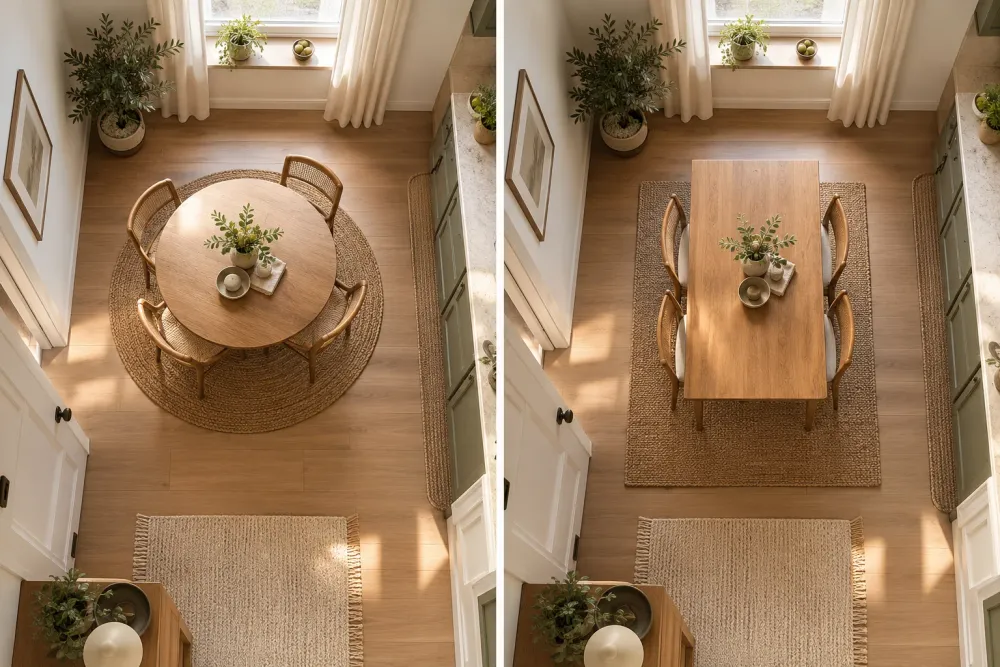
A round pedestal table suits a nook approached from several directions, such as beside a window or at the edge of a living area. Its curved top has no corners to navigate, while a central base can make chair placement more flexible than four outer legs. It is a conversational option for two people who do not want to assign one side to a wall. Check the base diameter separately from the tabletop: a wide pedestal can interfere with feet even when the top looks compact. A circle may also leave awkward gaps against a straight wall, so compare its occupied footprint with a square table.
2. Square two-person table
A square table sits neatly against a wall while leaving two sides available for everyday meals. Position one chair opposite the wall and another on an adjacent side if that preserves a better route; sitting directly across from each other is not essential. Check the distance between the legs and the height beneath the apron, along with chair backs and arms, if the chairs need to tuck in. A chair that remains outside the table footprint can consume more floor area than expected. Square corners can also feel intrusive beside a busy passage, though a shallow tray can keep everyday essentials contained.
3. Wall-side rectangular table
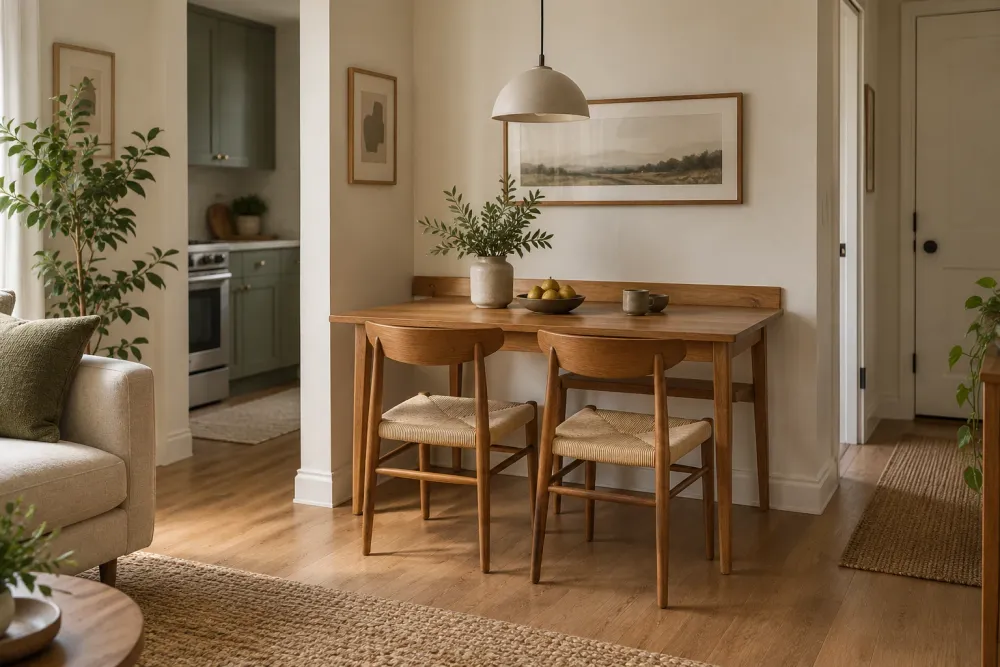
A rectangular table with one long edge against a wall provides eating and work space without occupying the center of the room. It suits a long, narrow wall, especially when the open side remains accessible from the living area. Keep an end available for a chair if two people would otherwise crowd the same side, and check whether someone can pass occupied chairs when necessary. Consider outlets, heaters, window treatments and doors when choosing the wall. A slim top may fit the room but leave little depth for serving dishes or a laptop beside a plate, so compare it with the items you use together.
4. Drop-leaf table
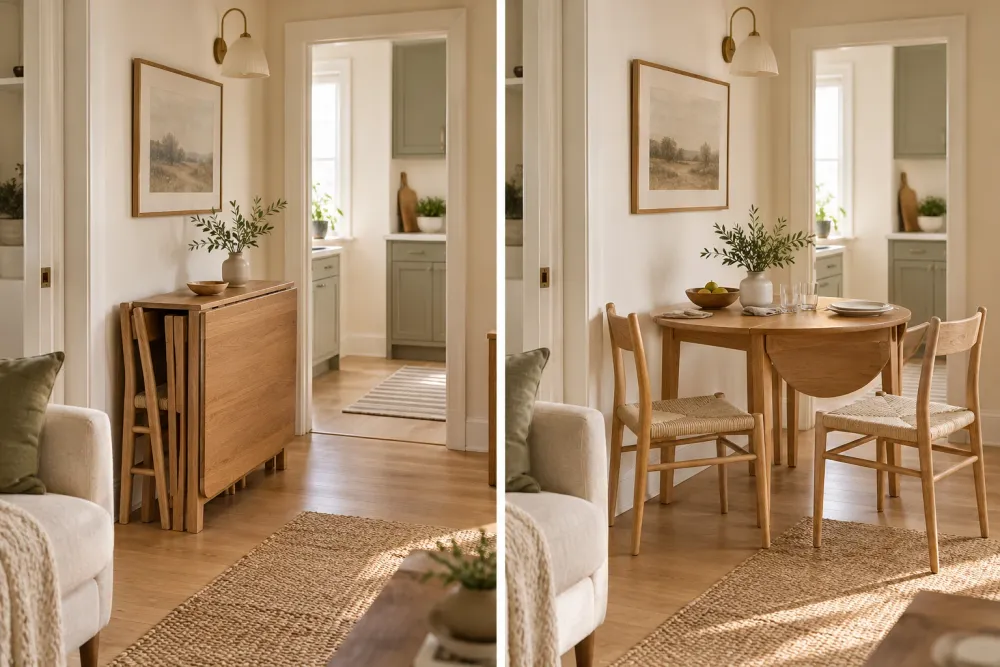
A drop-leaf table offers a compact everyday surface with extra room for occasional dinners. With the leaves down, it may sit against a wall or act as a console; some two-panel designs let you raise just one side. Check the dimensions in every intended configuration, including supports, and make sure a raised leaf will not block a door or push a chair into a circulation route. Examine the locking or support mechanism and follow the manufacturer’s weight limits rather than treating a leaf as an unsupported shelf. The tradeoffs are setup time and potentially restricted legroom near hinges or supports.
5. Corner freestanding bench
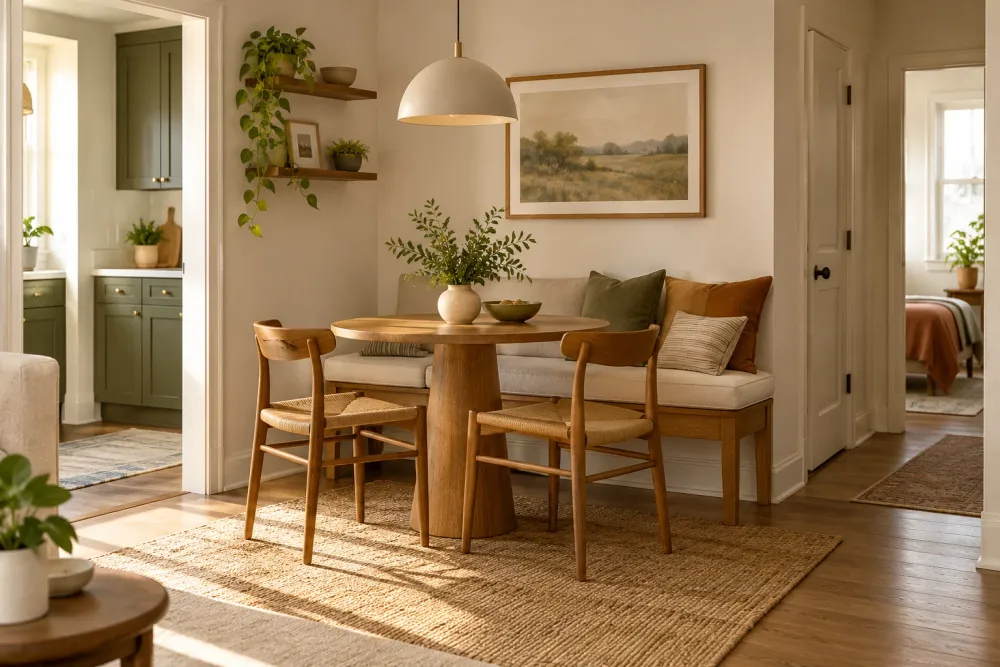
A freestanding bench can turn a corner into a cozy nook without a built-in renovation. Pair one bench with a small table, or use two separate benches only when the corner and access routes accommodate them. Include the back and cushion overhang when measuring depth, and allow enough room between bench and table for someone to slide in. Unlike chairs, a bench may require the person nearest the open end to move before a corner sitter can leave. Check that any storage lid opens with the table in place, store dry supplies inside, and confirm the bench is stable without improvised wall fixings.
6. Slim counter-height table
A counter-height table can create a casual perch along a wall or behind a sofa, particularly when the nook also serves as a coffee or laptop spot. Stools with backs may offer more support for longer meals, while backless designs may tuck away more completely. Compare seat height with the table’s underside, including any apron, to assess knee room, and consider whether getting onto a taller stool suits everyone. A narrow top offers less space for shared dishes. If a kettle or other heat appliance is nearby, use a safe, open operating surface, follow its manufacturer’s instructions and keep cabinet or cart contents dry.
7. Flexible folding table
A folding table suits a room that needs to change function between meals, stretching or play. It works best when both the table and chairs have convenient, dry storage and are manageable to carry and retrieve. Check folded height, width and thickness, including protruding hinges, as well as the open footprint, leg placement and locking mechanism. Set the table up on a level surface according to the manufacturer’s directions, and stay within its weight rating. Folding designs offer flexibility rather than a permanent visual anchor, but a washable cloth or small placemats can make the arrangement feel intentional without adding bulky accessories.
Your first refresh
Clear the proposed nook and measure its fixed boundaries. Tape out your two strongest options and test them at a normal mealtime, with chairs pulled out and doors opening. Choose the layout that supports your routines, then select seating that fits beneath the table. Before ordering, verify delivery dimensions and mechanisms. Add washable textiles and a small tray after setup, and adjust chair positions or table orientation once you have lived with the arrangement.
Questions before you start
Is a round or rectangular table better for a narrow dining nook?
A wall-side rectangle often uses a long, straight wall well, while a round pedestal can ease approaches from several directions. Neither automatically takes less usable space. Compare their complete occupied footprints, including pulled-out chairs, and test the route beside each before deciding.
Can I fit a dining nook beside a kitchen appliance?
Possibly, if the table and occupied chairs do not obstruct the appliance door, operation or your route. Check the full door swing and follow the manufacturer’s clearance and operating instructions. Heat appliances need a safe, open operating surface; keep cabinet and cart supplies dry.
Where should extra chairs go when I use a drop-leaf or folding table?
A closet or other storage area may work if it accommodates the chairs folded or stacked as intended. Measure that configuration before buying, and choose a location convenient enough for retrieval. Never store chairs where they obstruct an exit or prevent a door from opening.
How can I decorate the nook without losing usable space?
Try one low, stable vessel or a small tray that can move before a meal. Set out your usual plates and glasses first, then add decoration only if the table remains comfortable to use. Give the display a nearby landing place that does not obstruct movement.
Keep planning your space
For a dining area shared with the sofa, explore these narrow living room layout ideas and cozy small living room ideas. For personality without a built-in treatment, consider renter-friendly wall decor after checking your lease and the mounting instructions. Choose an approach that leaves the dining area and its everyday routes usable.